Monday, 11 June 2012


My next visit was targeted towards the functioning and the marketing aspects of the Valluvar Arts and Crafts Shop. Mr Kannan told me that the average turnover of the shop was nearly 20 lakhs per year. That’s a whopping amount I had thought. I guess he understood my expressions and told me that most of the revenue goes into paying the labourers and importing the stone. One more thing he told me was that he even had some statues made from Metal Panchlok which is an amalgam of 5 metals, copper, bronze, iron, aluminium and silver. They even created sandalwood crafts but that depends on customer needs and wants. 

The peak season for his shop was from November to march as the foreigners visit mahabalipuram that time around. That was the period in which he made most of the profits. The shop is opens at 9:00am and closes at 9:00pm, 7 days a week. All in all I found out that managing a shop is not that easy as it looks from outside. One has to take into consideration so many things like the customer needs, their likings as well as dislikings. Selling the product at the end of the day is the THE THING to do. Right from the creation of the sculpture to the packing to the transport is the responsibility of the shop.

 Creating strategies and making them work out is the toughest job to do when you are the owner and everything under the sun is your responsibility.

Skirting around in Mahabalipuram

 Coming from a field of fashion and stuck in a place with blistering heat, with nothing but denims, I had been eagerly looking to find a fabric shop where I could design something for myself. With my first few visits to Mahabalipuram, my hopes of finding a tailor and a fabrics shop dwindled. But this time around, when I went to Mahabalipuram with the purpose of doing a market research, I decided to walk the by lanes and find something unique I could write about. To my surprise I found this fabrics shop tucked between a local shoe shop and a handicrafts shop called Ponn.

I went in to explore the shop and the variety of fabrics available.I looked around and found two racks of ready-made clothes on display and a pile of old sarees lying in a corner of the shop. It was time to do the questions part, so I started with greetings in Tamil but sensing my discomfort, the shop owner quickly switched to English to help me with my queries. I started by introducing myself and my purpose of being there. I inquired about his name, his business and his customer base.

 Here is what I found out: His name was Mr Lingam who was dealing with exports of women’s kurtas, skirts and cotton pyjamas and chiffon and georgette dresses. He had been in this business for over 30 years now, which was started by his father and now managed by him and his brother.  Later he expanded into making custom made outfits as well. His main customer base consisted of foreign tourists who frequented this area mostly from September to January.

I inquired about the prices of a few fabrics and also the stitching costs and following were my observations:
  • The fabrics in his shop were priced at about 20-40% higher than the normal price available in the market.
  • He was overstaffed. He employed 6 workers in his shop who mostly used to be idle during off season.
  • He focused mostly on western wear because of which he missed out on the opportunity of the local population being his customer base. 
  • He stocked chiffons, georgettes, cambric and varieties of silk. Most of which were not summer fabrics.
  •  He was low on stocks of cotton especially cheaper variety of cotton namely mal which ranges between 50/-80/- rupees a metre, instead he stocked only cambric which started at Rs 160/- a metre.
  •  His stitching costs though not very high were not attractive enough, though after gathering information  from a few customers I understood that he charged different prices from different customers.
      Glad to have found a tailor, I finally decided to get a full length cotton skirt made. The price he charged was 650/- rupees which was more than what I had expected, given the place, but what I did get impressed with, was his turn around time. He committed to deliver the outfit to me in less than 24 hours and he did!

      Done with having placed an order, I then decided to get some idea about the shop’s standing from the visitors and locals in the area and this is what I found:

      My findings were that the tourists preferred to buy ready outfits in bulk. Even though the delivery time was short they preferred to buy what they could see and readily pick up from the rack. From the price point of view, the foreigners, even though charged higher were happy with the prices. The locals mostly did not know about shop. The few who did know about the shop did not find it of any interest to them as it mainly stocked items of clothing like skirts and trousers. They instead purchased low priced Indian wear from a nearby shop. 

      From my interaction with Mr Lingam and a few customers I concluded with the following thoughts: the owner could expand his customer base by bringing in low priced Indian wear as this could help not just use his work force throughout the year but also reduce his dependency on the 4 months of the year and help him stay afloat during the off season.  With this I concluded my visit to the store determined to find come back and keep up with the journey of exploration.


Taming the Steel Bull - The Bike Mechanics at Royal Mechanik Anupuram!!

                                                                                                                -Vidhul Dev(FT13187)

The flow of adrenaline that’s what comes to mind when we drive these great Bikes (motorcycles). The same emotion can turn into an horrendous spit of anger when your dear lil monstor fails to pull you through and goes down due to technical glitches. Now this is the time you look around for a Mechanic and you don’t find him..can you imagine the plethora of emotions that a person under such a situation!
Well.. in this small town of Anupuram, there are only two places or shops if you want to call them who can fulfill your bike servicing needs. Mr Govindan runs this mechanic shop an old timer at servicing and repairing works, have an experience of handling almost all the two wheelers  right from good old LML and Bajaj Chetak.
Sundays are hectic given the fact that most of the customers are free to look into this impending small works. You have a vehicle to give for servicing and fix some glitches then this isn’t the right time to come here. The town has only two bike servicing shops and they are jam-packed with bikes and you see the queue dragged to roads.
On a small discussion while his ‘boys’ where busy at work I found that there is a huge demand for this work, and great business. There is no competition from “The Biggies”- The branded servicing centers in a rural market as they simply shut their eyes to the rural market. “They do not understand that there is quite a lot of disposable income with the small town people to buy the glossy 2-wheeler automobiles and a huge possibility of business as well” says Govindan.
I observed, Patience as the biggest asset to come to mechanic on Sunday. Checked with the owner, the problem he says lies with the small workshop space and unavailability of the skilled labor. The localites form the major chunk of the the customers and they are the ones who promote the place as well. They have the routine of leaving the vehicle and take it back in the evening or next day.
Sometimes the parts aren’t available and the owner has some ‘settings’ to get the stock from Chennai on Thursdays.


Overall the customer sounded satisfied with the service, but the time and the availability of parts they tell are the issues. The mechanics are mainly the young lads living in the nearby villages students of tenth standard,  the owner says their aren’t enough people with the right skills to work here. These kids are very quick in mastering the skills and they fast in delivering the bikes as well.
It’s a huge learning process that this monopolistic establishment of sorts makes the call on its own. The people make not much of hues and cries about the time lag of delivery. The business will improve as the lower middle class junta of our villages start going for bigger bikes. But the question is where are we going to get the skilled labor and how will the customer come out of the restrictions imposed!


                          In Decennial Year of Service - Ganesh Juice Shop

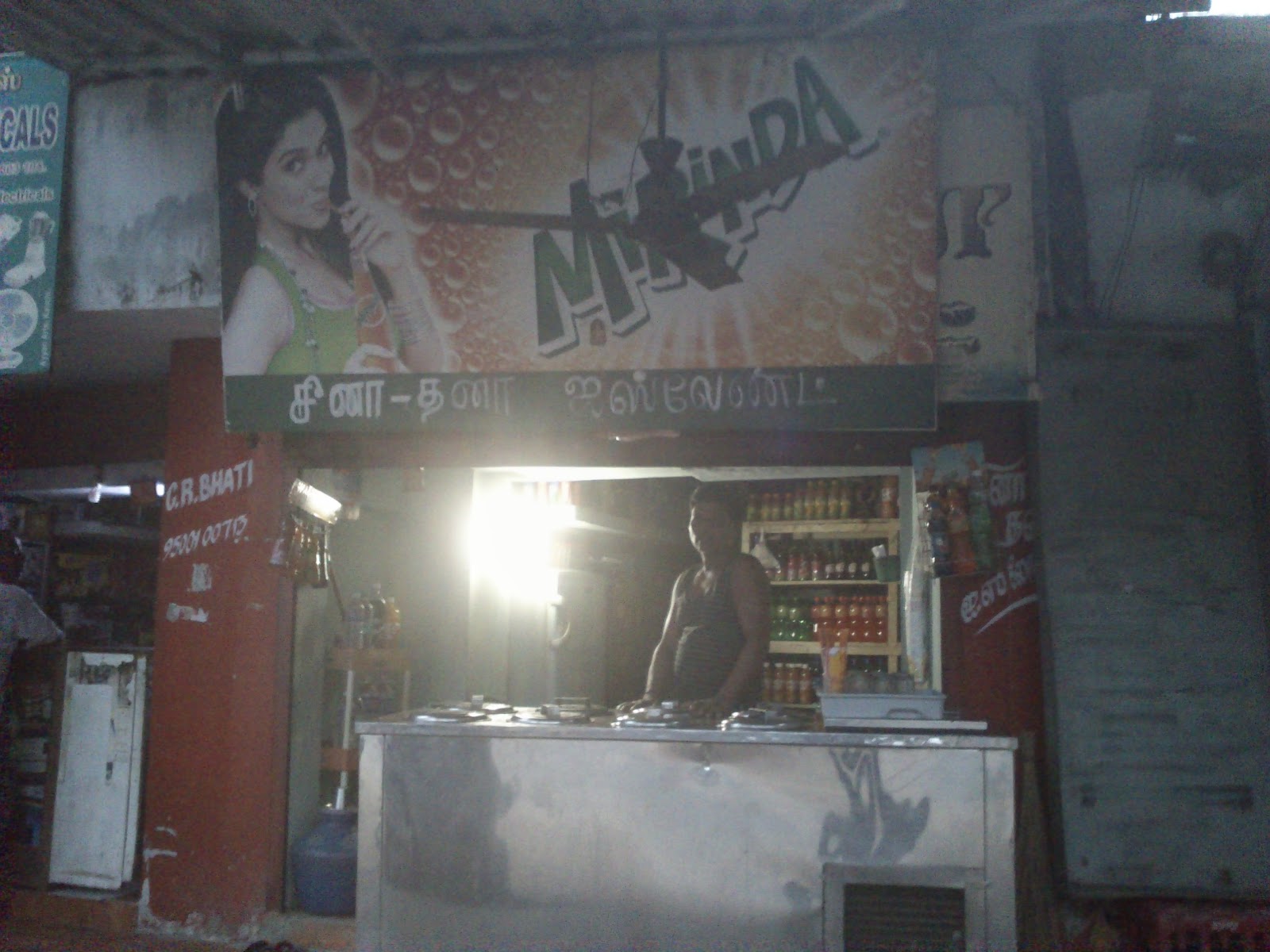
The idea of observing the business cycle of “Ganesh Juice Shop” in Mahabalipuram struck me when I was surveying the customers for the Marketing Management Group Project. After few days, I visited this shop around 4:00 PM and started noticing the setup around.
The shop under observation is one of the oldest juice shops in the town; started 10 years back by Ganapathy.S(Age: 45 Years) and is open from 9:00 AM to 9:00 PM every day.  The shop is around 8 * 10 feet in measure, leaving enough space for every item to be kept in the shop, with a small portico for customers to stand. Portico had a fan running to relax the customers while they were having juice and to drive away the houseflies. The board of the shop was large enough to be viewed from a bit far and the various juices that he sold were Lemon, Badam Milk, Mixed Fruit Juice, Rose Milk, all prepared by the shop owner at home.
I noticed that the customers even went on having 2-3 glasses of juice, especially the teenagers, which meant that the customers did consider “Ganesh Juice Shop” as a very good option for juices.

These juices are priced at Rs 10 a glass.

Basic Setup used to run this juice shop included:
  •   A cooler to keep the juices cool.
  •   A fridge to hold stock of juices.
Survey Data in figures:
Frequency was around 20 customers in 12 mins during peak time.
Peak Time: 11: 00 AM to 5:00 PM
Peak Period: Feb-Mar, June-July
Maximum no of Consumers were college students & school students. College students were mostly from nearby colleges such as “Dhanalakshmi Engg College” and “Royal Engg College”.
Preferred juice of most customers: Mixed Fruit Juice


Various methods used by the Shop Owner to attract, satisfy and retain customers are

  •  Selling of Lays and water bottle. Idea behind this move is to sell these to women who come to have juice. Women would be tempted to buy Lays for their children.
  •   Music was being played to satisfy the customers beyond the actual purpose of serving good quality and tasty juice.
  • Shop owner always picked up conversation with new customers asking them feedback about the juice (tried to build relationship) or started asking personal welfare with his loyal customers(Aims at long-term relationship). Long-time customers did respond very well to his questions.
  • Selling of soft drinks such as Coke, Pepsi to keep customers interested in his shop, although he earns maximum profits on the juices that he sells. He said that he just makes a profit of Rs 1 when he sells a half-litre Coke or Pepsi bottle.
  •  Importance of cleanliness is focused on a large extent in this juice shop. He kept on wiping his coolers with wet cloth, washed the used glasses as soon as the customer had his juice, set up a dustbin for the customers to throw the plastic glasses once used.
  • The shop is famous for the tasty juices it serves.
  • Planted a tree 10 years back when he first started his shop to provide some shade, fresh air to his customers. 
  •  Striking feature is the ban on smoking in his shop. Logic he gave was that smoking would turn off the women who visited his shop.
  • Table, juices, soft drinks, lays etc were arranged really well so that all of the products he sold were very visible to the customers.
  • Mr.Ganapathy had the knack to crack jokes with kids and switch to mature talk when conversing with adults. Basic aim is to satisfy and retain the customers.
  •  Shop Owner adds that many people know his shop because of the quality and the tasty juice that he provides.  This is the basic reason for his success when there are 10 other juice shops in the vicinity. “Word Of Mouth” helped him to establish a good image of his juice shop on the customer’s mind. 
  •  Mr.Ganapathy politely says “Visit Again” when the customer had enjoyed his juice and is about to leave the shop.
  •  Mr.Ganapathy is helped by his son Mr.Vallavan(Age:21 Years) who runs the shop in the evenings after coming back from college.  Mr.Ganapathy conveys that his son tries new things with the juice and brings out new taste. His son adds seasonal fruits in the mixed fruit juice to give new taste.

From my observation of this happening shop and the interaction with Mr.Ganapathy , I could sense that he treats “Customers as King”. He has also understood the importance of diversity of his customers in women, college students, their preferences and the need for new flavors.

After, noting down these points, I did have a delicious mixed fruit juice to experience the magic of “Ganesh Juice Shop”.


Rishabh Baiswar ( FT13159)

Marketing in Non-Competitive Market- Akshaya Hotel (SWOT Analysis)

The closest town to Great Lakes is 9 km away. One of my vices includes alcoholic beverages and Akshaya is the closest and most effortless place to indulge. Having lived in proper cities, I never had a chance to be a regular at a place which is not even as good as a "Dhaba" on North Indian highways.

Great Lakes has people from all walks of life who are experienced and mature. The percentage of alcohol consumers and non-vegetarians is equal to what it would be in this age group of 25 plus across India. This fact gives Akshaya a strategic advantage due to its location right outside the institute gates.

Akshaya is the first choice among all Great Lakers due to following reasons-

1) Proximity
2) Non-veg food
3) Alcohol

The primary reason is proximity only as food and liquor served are quite sub-standard.

Liquor served does not have any variety in terms of category as beer is the only beverage available. Most of the times, beer is not even cold enough let alone chilled. The brands available never heard of and it doesn’t matter you are having a Kingfisher Lager or some brand called Kalyani, they are priced at Rs. 125 flat. The food menu does not have anything much to offer. There are not more than 8-10 items which are available and most of the times they too elude us. The service quality is poor in the sense that there are only 2 waiters who double as cooks as and when required.

Having said that, I would like to analyze the situation now. The reason behind Hotel Akshaya's positioning is that it does not have to face any sort of competition. Lack of competition has made its management complacent in terms of service quality. The management knows that all beer guzzling souls will head to them as soon as the frequent craving for a chilled beer stimulates them, which is quite frequent.

The situation doesn't mean the management is not at all concerned for the consumers. Its just that they are not enough motivated to improve as the business is profitable anyways. After repeated requests for better food variety and liquor, on one of the weekend eves, to my surprise I found that there was a special food menu(refer picture). The menu included all dishes we have been requesting for. I did not even expect them to even try for consumer satisfaction given the scenario. But they did try, though the attempt went futile as it clashed with a party already planned in Mammalapuram pub "Bay Treasure" and most of the students already left the for it before the word about Akshaya could have got out. This remains their one and only attempt till now.

This makes me conclude that in non-competitive hospitality market, small players like Akshaya might want to achieve customer satisfaction in spite of absence of competitors but they cannot remain invested in the effort as they don't have deep pockets. They will do so only if they earn enough to stay motivated on their trial day. It might click though if Akshaya plans it beforehand and spreads a word of mouth about its special arrangements and students do turn up. The profits earned will keep it motivated to try and position itself better. I have also done a SWOT analysis below:

SWOT Analysis-

Strengths - The most prominent strength of Akshaya is its location. Akshaya would not survive a day in even a slightly competitive market given its current state. The location close to a mature student population and away from competitors keeps it at an advantage. The other strengths include a TV where all sports are played and gives consumers an advantage of watching games while dining, a luxury unavailable in the campus. Another strength is availability of AC as well as Non-AC dining space and Non-Veg Food.

Weaknesses - Lack of variety in alcoholic beverages and food and poor food quality. The service is another weakness which is a consequence of under-staffing. Lack of motivation to provide customer satisfaction. Inadequate storage facility also adds to it. Lack of funds might also be one of the causes to under invest in marketing.

Opportunities - Great Lakes is a huge potential market for it. Students come from a professional background and have certain level of purchasing power. The market can be tapped to maximum in case Akshaya management decides to improve its services in order to achieve customer satisfaction.

Threats - The biggest threat is monotonity of the menu. As most of the people have convenience issues in travel, people dont mind ending up at Akshaya but once people get familiar to the place with time, they might want to try new places in Mamallapuram and beyond. They will only go to Akshay in a situation when there is certain level of variety.

Rishabh Baiswar(FT13159)


                                                             “Lingam General Store”

The shop owner, Mr. A.K.Natarajan, established the shop in early 70’s with an initial investment of Rs.5000. For this venture, he was also supported by his brothers of the monetary help, who had established many businesses around Mahabalipuram on their own.

The key points noted are:
·         The store is open every day, barring the national holidays. Store Timings are from 8:30 AM – 9:30 PM with a considerable 2 hr lunch break from 2 – 4 PM.
·         Whole of the inventory management is done manually; Mr. Natarajan was successfully able to keep a tap on the workings of his store with the help of a single helper alone.
·         He reported that the footfall was more on the weekends as compared to weekdays, where the majority comprised of tourists and sometimes the locals.
·         Despite having a considerable sized store there was just one helper in the shop, to which Mr.Natarajan blamed that it was a tough task to get faithful workers. And also it was very difficult to keep an eye on too many helpers at the same time.
·         Replenishment techniques:
o   Milk was delivered by the vendor in the evenings, which was to be distributed the next day.
o   Snacks and eatables in 3-4 days.
o   Shampoos/soaps in 3-4 weeks.
o   Stationeries, in approximately 1 month.
·         The income is deposited in the Indian overseas bank, located nearby, on the regular basis.
·         Every six months the shop is monitored and cleaned to check for damaged, expired and spoilt goods, which are then returned to their respective vendors. The corresponding amount is adjusted in the future orders, but no money exchanged hands.
·         He also mentioned that whenever a new product is launched by a company, the shop is never provided with any free trial samples. So keeping the risk factor in mind, the shop owner bought only a handful of items and monitored the customers response before ordering the same items, the next time.
·       There was no specific process of reporting/recording the profits incurred in the business.
·         In the early years, when he could trust his customers, he would give credit sometimes, but since the last few years he had to deal with many defaulters. As a result he has stopped giving credit.
·         It was also noted that a customer when purchasing a durable good(like a pair of scissors) for the first time, enquired about the product from the shopkeeper first and then after being sure of making the necessary checks and parameters , he had in mind(price, smoothness, sharpness) would actually buy it. Customers were taking less time to buy a product which they had already used or decided to buy before arriving at the shop.
·         He also reported that the replenishment was done for different goods based on the funds he had, and according to the 4 basic principles of demand and supply.
·         The goods were arranged in such a way that each shelf was occupied with similar goods (i.e. oils, shampoos, body spray of different brands clubbed together). This would reduce the time required to deliver the product to the customer as well as giving a wider choice to the customer.
·         I also noted that if the owner felt that a offer was going on a product which the customer was there to purchase and was unaware of the offer, he would apprise the customer of the same. This would help to benefit both the customer satisfaction as well as the sales of the store.


Suggested changes to reduce the manual effort put into the running of the store
·         The Inventory records can be fed into a computer system, which would keep a track of quantity of different goods, amount of sales, which would in turn reduce the time required to flip through the pages to check the records.
·         The profits can also be calculated in the computer system, and the shop owner can take decisions on the further enhancements of the shop facilities and hence take the business further and take proper replenishment decisions, instead of relying on the gut feeling.
·         Also as in urban areas, it is common to get free samples of FMCG goods for consumer trails. This can also be introduced in the rural areas, if the cost associated with it is justified.

Last but not the least i would like to thank Mr. Natarajan for allowing me to have an experience of how his shop is run.